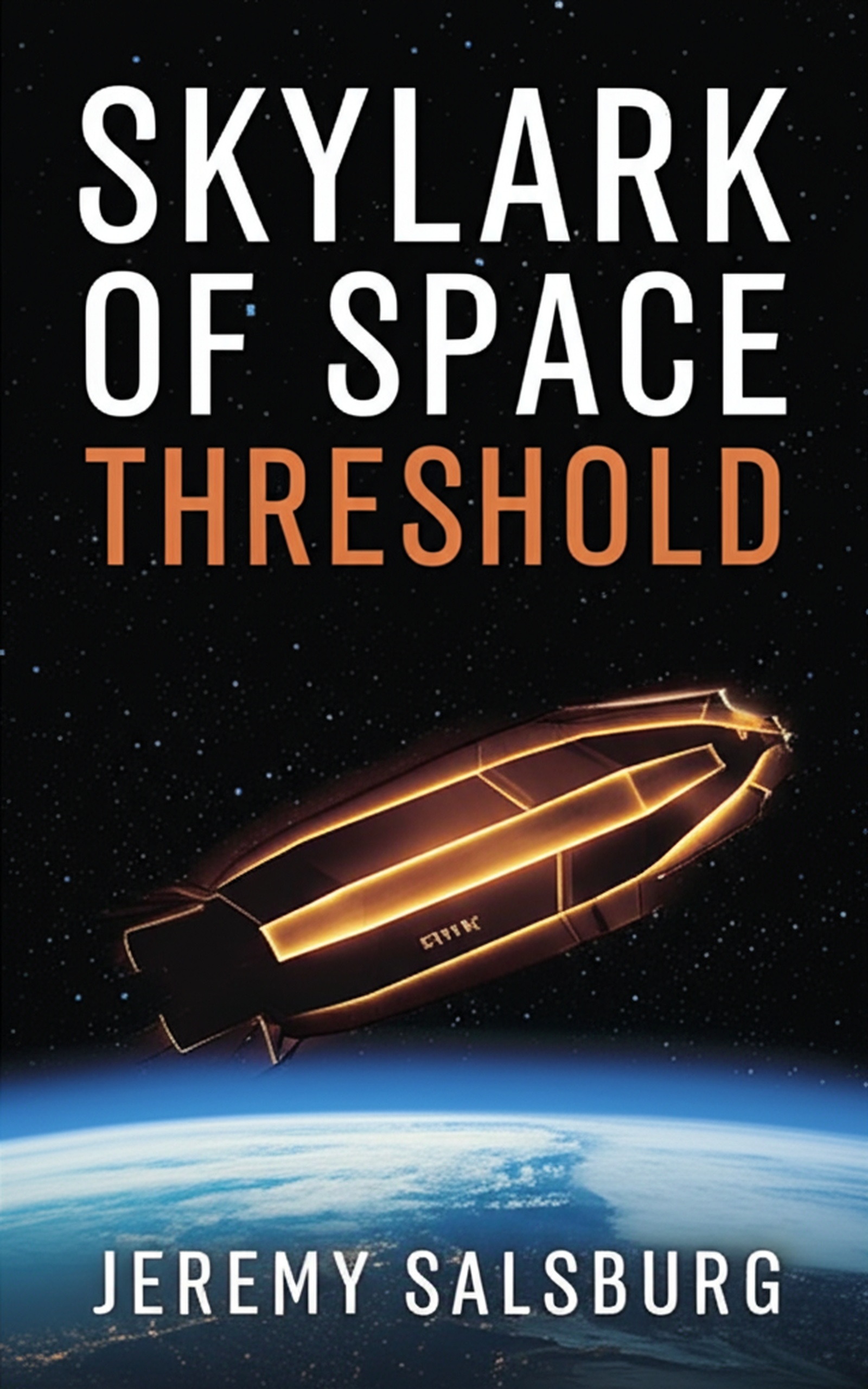
Four Acts. One Escalation.
Dr. Nate Seaton, an underfunded materials scientist in Portland, accidentally creates a thin film that produces thrust from electrical input. No propellant. No exhaust. Just force. Martin Crane — an old friend and clean-energy CEO — helps verify and fund the discovery. But Nate's lab was hacked three days before the accident, and Dr. Marc DuQuesne, a brilliant physicist working for Vanguard Strategic, already has partial data.
A race to build. Nate and Crane assemble a team and construct Skylark — a crude, nuclear-powered prototype — in a Portland hangar. DuQuesne builds Condor at a Nevada black site: bigger, faster, armed. The pressure escalates: cyber attacks, Senate testimony, an Air Force general offering protection-with-strings, and then Vanguard kidnaps Dorothy Vaneman, the team's mission architect. Both ships launch within hours of each other.
The confrontation moves to orbit, then past the Moon, then into deep space. Skylark is outgunned and marginal. Condor is faster but thermally flawed. A lunar slingshot. Dorothy's EVA between ships — five minutes of near-silence. An uneasy truce when both crews face the same enemy: the void. Then — a signal. Structured. Mathematical. Not from Earth.
An alien artifact — ancient, abandoned, still transmitting. Inside: a power source that makes S-films look like candles next to a fusion reactor. The rivalry between Seaton and DuQuesne dissolves in the face of what they've found. They return to Earth with proof that humanity is not alone — and a technology that changes everything.
Final image: Nate at a window, looking up. "The stars look different now. They look like addresses."